5/3/13

Baby Silkies


Review of - Chickens in Five Minutes a Day


Chickens in Five Minutes a Day by Murray McMurray Hatchery
Raising, tending and getting eggs from a small backyard flock.

Murray McMurray Hatchery has just published this nice simple book about caring for chickens “In five minutes a day”. The main point of this book is – caring for hens is not complicated and doesn’t have to take a lot of time, 5 minutes a day. As Mr Huseman and employee at the hatchery says “The task of raising chickens at first seemed daunting, especially because I didn’t grow up on a farm. We only had a dog. I remember thinking what are we getting into? But it’s easy. The chickens just need food, water and shelter. That’s it”

The book has a nice seasonal guide for raising chickens and also a daily guide, below are some of the steps outlined in the book:

Watering – “Your chickens need access to clean water every day” I would add, even in the dark cold frozen winter. It can be a challenge in the winter making sure the hens have access to water 24 hours a day. I use a heated dog bowl to ensure this.

Feeding – “A balance chicken feed that is stored in pest – proof containers and housed near the coop for easy access”. I would also add consider adding some diatemaecous earth to your feed to help manage lice. Simply toss a small amount on your feed when loading it into your pest proof container.

Collecting – “When your chickens start laying eggs, you should check the nesting boxes in the coop at least once a day for fresh eggs”. When I go to the barn I simply take a peek in to see if there are any eggs. Just a note that hens need lots of light in order to lay eggs. We have clear panels in the roof of the barn so that even when the hens are in the inside coop, not out in the outdoor run, they are exposed to natural light.

Observing – “Good backyard farmers get to know their chickens and can spot lethargy, loss of appetite and other symptoms that might be the first signs of illness”. This is a very important part of raising hens. Knowing and understanding your hens is critical: are they broody, do they have lice, is anyone on the bottom of the pecking order, are the nesting boxes clean, is the coop completely safe (no holes in the fence for predators)

My favorite section in the book is "Choosing your Chickens". There are some very useful tips in this section for example, what is the right sized flock for your backyard?, Which chickens are best for you and your location, and breeds listed by temperament, multi colored eggs or exotic looking birds. Honestly I want all of them. I have 32 birds of various breeds, bantams, standards, good egg producers, roosters, you name it I probably have it and it all works out.

Obviously, the section titled “Everything you need to know for those first few weeks” is very very complete, this is a book from MurrayMcMurray after all. If you are considering getting chicks, get this book. This section of the book gives you critical, life saving information on how to care for your new birds: Pasting up, how to introduce them to water, huddling, pecking order. Read this chapter, then read it again to make sure you have it all. 

There are only a few things I might think twice about. One is on page 110 "Tips for Protecting Your Chickens from Pests and Predators". This is a very critical part of the book, in fact I think one of the most important. I don't have much patience when neighborhood dogs attack and injure hens. I think it is our number one task to keep our chickens safe, at all times. So I would recommend chain link instead of chicken wire. Where I live a fox or coyote could easily get through chicken wire. Keep your hens safe and happy.

3/24/13

Review of HOMEGROWN HONEY BEES @storeypub

 This is a great book for getting started with beekeeping. It is organized very simply and is jam packed with great photography.

A few of the chapters are titled:
Why bees?
How do I get started?
The first month.
The first season.
Congratulations and condolences.

As you can see from the chapter titles the book is very practical but also weaves in a bit of humor. There are many very scientific focused books out there (my favorite is The Beekeeper's Handbook by Diana Sammataro - you have to have this book in your beek library). Homegrown Honey Bees is quite different which makes beekeeping seem very fun and not so intimidating. On page 66 there is a page about the 'gear' you will need to consider for beekeeping - the title is "Gorilla Suits and Other Inappropriate Dress". I actually think it would be awesome to tend bees in a gorilla suit.

The chapter I found most useful, as a rookie, was the Varroa Mite chapter. I have read quite a bit about Varroa, and seen them but for some reason I still feel as if I don't know anything about them.  They are mysterious. This book has a chapter with four bullet points for what to look for, this was incredibly helpful: Lots of brood cell cappings with small holes, indicating dead pupae, bees that are stunted or have shriveled wings (accompanied by very good pictures).

Lastly, throughout the book are pages dedicated to Urban Beekeepers from New York to New Mexico. These profiles of beeks are very interesting because it is fascinating to see and understand how other people tend to their hives. I am going to keep this book in my bee kit.


3/16/13

Thank you @ktranell and Scholastic Magazine

Thank you Kim Tranell and Scholastic Magazine for doing this article on teen bloggers.  It is a great article about building your own blog and what is possible. Also included in the article are bloggers @bentpieceofwire @jessenort and @donotenterdiary.

See entire article HERE

Lucky to speak @DoLecturesUSA last fall

I was really lucky to speak at the DoLectures last fall, with amazing people. My talk was about being a rookie and failing, failing all the time. Go to the site to check them out: Anjali Karki and her mom Maggie Doyne (I am hoping that maybe we could install some hives at their home in Nepal), Cheryl Strayed author of Wild, Charlie Engle, Brenda Chapman director of BRAVE to name just a few. 

All photos by Richard Beaven

Tipis

Anjali Karki, Kopila Valley Student

Charlie Engle, filmmaker (Running the Sahara), runner

Brenda Chapman, Director of BRAVE

A little spring cleaning @happyhoneybees

Always sad to lose a hive this late in the season. There is still plenty of honey in the hive and this was my strongest hive going into the winter. Hard to know what happened.

I think I am going to switch to open bottom boards. I think perhaps it was moisture? When I open up the entire hive I will take pictures.


2/8/13

"Reinventing the Chicken Coop" a review

Photos by Erin Kunkle
I just received this book in the mail from my friends at Storey PublishingReinventing the Chicken Coop 14 Original Designs with Step-by-Step Building Instructions by Matthew Wolpe and Kevin McElroy

It is amazing there are so many different kinds of coops - coops with gardens on the roof, spiral staircases, built in composting system, even the coop pictured above with a V shaped roof to collect rain water called Chick-In-A-Box (page 94). Each coop design has very detailed step-by-step plans with really helpful illustrations. I think just by looking at these photos you will be inspired to rethink your coop. I am. See on the picture below what the authors call “the water catchment system” – awesome. It’s a V shaped roof and a funnel that leads into the coop to water the hens. “The simple water catchment system collects runoff water from the lower end of the roof’s valley flashing and diverts it to a pan inside the coop”, ok that’s brilliant. I was once told that farmers are really problem solvers, they have to be. Here is the proof.

The book itself is has great pictures and very easy to follow directions with detailed drawings. My mom called this book the DWELL for chicken coops; I’m not exactly sure what she means except that the coops are well designed. She says, “Equal parts utility and style”. That’s true. The book is also labels each design: beginner, intermediate and advanced. This is really helpful before you get started and jump in.

The opening chapter of the book is called Chicken Coop Essentials. This is a great chapter with really useful information: General space requirements, coop and run setups, definitions of deep bedding, guidelines for roosts, nesting boxes, protection from predators / rodents, and ventilation to name a few. This isn’t just a how to build a coop book, it is a great chicken raising book for your library.

One of my favorite things to see was on page 91 the use of corrugated clear plastic for roofing. This is what I use on my outdoor run because in the winter in New England our hens need 14+ hours of light and it would be terribly expensive to keep the lights on that long, so the clear roof plus lights enables my hens to have plenty of light.

> Check out this book, it is very inspirational and has lots useful and helpful information. Also Storey Publishing has been super awesome to offer a copy of this book to one of the readers of this review. Leave a comment on the Happy Chickens FB (search Happy Chickens on Facebook)  and I will randomly pick a person  to get a copy of this book from Storey.

photo from justfinedesignbuild

1/10/13

Tamara Staples new book, The Magnificent Chicken @staplestamara


Susan


Photo by Tamara Staples of Happy Chickens


The new book by Tamara Staples 
I was lucky enough to meet Ms. Staples not long ago. I had always loved her book The Fairest Fowl and when we met she took this amazing photo of Susan ( named for @susanorlean another chicken fan who I spoke to for ChopChop Magazine) She now has a new book The Magnificent Chicken which looks really great.

Check it out.

1/7/13

Winter Chickens - What NOT to do.

Heated water bowl
Chickens in the winter – what not to do. 

1. Do not let the water freeze, even for a few hours overnight. Hens that get even just a little dehydrated are much more prone to getting weak and it takes them a very long time to get rehydrated, hens just aren't that thirsty in the winter. I do like heated dogbowls. Many don’t care for them, but I find them very very helpful. I am at school all day so am unable to tend them throughout a freezing cold day. I also put a little splash of Braggs into the water, I just think it is good for them. They like the taste so drink more water.

2. Do not let your eggs freeze. If they freeze they crack a bit from the expansion. A cracked egg isn't a good idea to eat. When I find cracked eggs I try and scramble them up for the hens. Many people will disagree with this, they will tell you that your hens are more likely to eat their own eggs as a result. They are probably right, but I haven't had that experience and they seem to love scrambled eggs. I hate to waste an egg. So collect the eggs more often when it is cold.

3. Do not heat or insulate your coop too tightly. While it is true you don't want big drafts rolling through the coop a tight coop is just as bad. When chickens breath they put moisture in the air and because they spend more time in their coop in the winter there is just is more moisture in the coop in general from breathing and droppings. Moisture and humidity can create an unhealthy situation with mold and potential respiratory issues. Also a really tight coop can have the smell of ammonia to build up which can be terrible for you and the hens. A good guide is protected, well ventilated and not drafty.

4. Do not let your hens get bored. Cut up a squash, sprinkle corn cobs around, hang a cabbage, put a roost in a new spot. I don't think they need "toys" they just like scratching about for snacks.

5. Do not deprive your hens from light. Let your chickens out of the coop for a walkabout, let them out in the winter even in the snow. Don't keep them cooped up in the coop (make sure they are protected). Chickens need lots of light to continue to lay through the winter. I use lights on timers. It costs more in electric bills, however hens need light. I also have covered their outdoor run in clear corrugated plastic roofing so when they not in their nesting boxes they have access to natural light.

6. Do not forget to go over each bird to look for signs of cold distress. Do this often. I apply Vaseline to their combs in the winter. Also make sure the coop is clean: see moisture above. A good technique in the winter is the Deep Bedding Method. It is very easy to manage, you end up with compost, they birds are always entertained scratching about, and it keeps your birds healthy.

Time for a picture of Eunice. She is awesome.


#BeeChat every Sunday 2pm PDT / 5pm EDT / 10 GMT

Join us every Sunday for #BeeChat
2pm PDT / 5pm EDT / 10pm GMT
over on Twitter.com

The idea is to have #beekeepers get together and share information, ask questions and help each other ultimately to help #bees.

This past Sunday we had roughly 20 beeks from:
Australia
California
Italy
Cape Town South Africa
Los Angeles
Atlanta Georgia
Hawarden Flintshire UK

Turlock CA
Lockington Driffied East Yorkshire North Wales
Ohio


It was very inspiring and helpful. Spread the word.


12/23/12

Water in the winter for happy chickens

Water is the most important thing for your chickens. It is just as important in the winter as it is in the heat of the summer.

• Every day make sure your waterers are full.

• Check your waterers every week for algae and basic junk. Your hens need clean fresh water. Hens will be less likely to drink dirty water and it takes a long time for a hen to get over dehydration. If they become too dehydrated they can get very ill and even die.

• Make sure your hens are "bright" and behaving the way they usually do. If they seem lethargic or depressed make sure they have fresh water first!


• I often add a quick dash of Braggs to the water. I believe it helps with their digestion and they seem to love the taste of it!

• It is possible to leave your chickens for a few days - only if there is plenty of food and fresh water. I always have someone check on them every day.

12/19/12

Honey Holidays

Wow.
Sent 10 jars of honey to my mom's friend in Portland Maine. She is an amazing photographer named Winky Lewis. When she opened the package she took these pictures. Yes, when shipping honey we have learned to put them in a little bag...otherwise the entire package could be drenched in honey.

Thank You Ms. Lewis.


11/28/12

Kinda awesome, article from Poland.

CLICK HERE to read the english

Ten chłopak imponuje

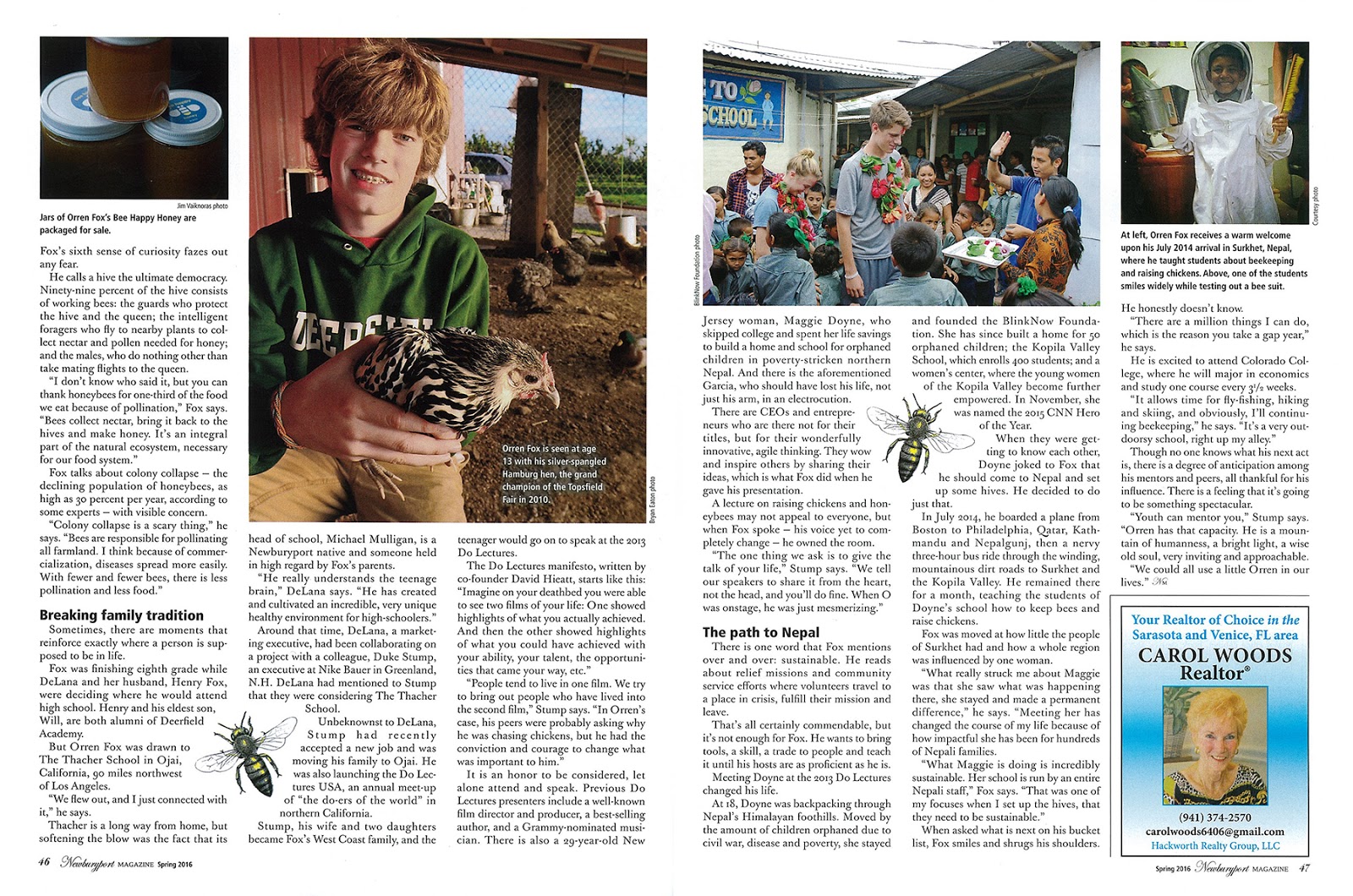
Jeżeli komukolwiek pszczelarzenie kojarzy się wyłącznie z sędziwymi byłymi wojskowymi powinien poczytać bloga tego chłopaka. Piętnastoletni Orren Fox nie dość, że hoduje pszczoły w niewielkiej, czteropniowej pasiece, to jeszcze ma kury i kaczki a wszystko bardzo regularnie opisuje tu - na "Happy Chickens Lay Healthy Eggs" (proszę nie pytać, jak trafiłem w to miejsce, ważne, że znalazłem).

Tak się składa, że w pierwszej kolejności to miały być u nas właśnie kury, a dopiero później ewentualnie pszczoły. Potoczyło się inaczej, ale to wcale nie oznacza rezygnacji z pierwszej części. Wspomniany blog jest dobitnym dowodem, że jest to udane połączenie. Na tyle udane, że Młody był zaproszony do Białego Domu i jest poniekąd gwiazdą medialną (wystarczy przeglądnąć listę jego wywiadów). Wspominam o tym nie dlatego, że, wzorem Foxa, chcę być zaproszonym do Pałacu Prezydenckiego i marzy mi się wywiad w "Gazecie Wyborczej", ale aby podkreślić uznanie dla piętnastolatka. No i lektura sama w sobie jest naprawdę fajna - gorąco polecam.


11/4/12

Failing is Just as Important


From Handpickednation.com

I was really lucky to be invited to speak at the DoLectures this September in Hopland, CA. It is a weekend of “Inspiring talks from people who are changing the world.” I am 100% sure I am not changing the world, nor do I think my talk was so inspiring, but it was super fun to get up in front of about 150 people and talk to them about taking risks, failure, the feeling of success, responsibility and oh, about raising chickens and keeping bees.

There were so many amazing people speaking:
Cheryl Strayed, author of Wild
Brenda Chapman, director of Brave
Charlie Engle, featured in Running the Sahara
Maggie Doyne and her daughter Anjali from Kopila Valley and BlinkNow
Chief Arvol Looking Horse
Sean Baker, executive chef and co-owner of Gather restaurant
Meredy Benson, Oak Grove School
James Freeman, founder of Blue Bottle Coffee
Adam Stofsky, founder of the New Media Advocacy Project
John Andreliunas, president of Quoddy
Catherine Biley and Robin Petravic owners of Heath Ceramics
Melinda Kramer, founder of Women’s Earth Alliance
Alessandra Lariu, co-founder of SheSays
Ken Boek, gardener (I want to be Ken when I grow up)

I made a short video with Michael Piazza and working with him was amazing. We made the film to share with the people at the DoLectures and let them know what it is like to be near bees, what they sound like and how exciting it is to pull a frame out that is filled with honey! Michael is an amazing person, very gentle and really interested in what I was doing. He came to the hives 3 times and during one visit he set up a little 'recording studio' in our kitchen to record my voice.


Here is the gist of the talk I gave:

I became interested in hens when I was 9. I just woke up one morning and was fascinated by them. I’m not exactly sure what it was, but I thought they were amazing. Luckily, we live near a bunch of farms and I started volunteering at one of them for an awesome farmer named Julie. She was tough and expected a lot. I swept the barn, fed her birds and goats, and carried 50 bags of feed and shavings. After having been there about a year she said, “you should have your own hens.” I practically burst into tears I was so happy. Then the responsibility really began. I had 12 hens that I had to tend to everyday after school. Paprika, Plum, Cheesecake, and Alice taught me a lot, primarily about responsibility. When it was 19 degrees below zero and dark, I had to go and clean their water bowls, put Vaseline on their combs… make sure they were okay. It was often hard and even though I cared about my hens, I didn’t really want to go out to the barn... but there is no room for “I don’t want to go.” Sometimes I couldn’t go to sleep in the middle of the winter because I was thinking about them.

My hens taught me not to be overwhelmed by “what ifs”. What if they die, what if they get sick, or what if you don’t know what your are doing? I had no idea what I was doing, really. It can be humbling and even scary, but so what? Limits are in your head. Don’t let being a beginner prevent you from doing something you are excited about. Everyone starts out as a beginner. Actually, I hope I never become an expert because being a beginner means you can make tons of mistakes and you can ask a ton of questions. I always want to be a beginner. There will always be “what ifs” even when you have a bunch of experience, the questions are just different.

I decided to start a blog (really an online journal). I just put random stuff up on it. It was only for me, so I would remember things and could compare information from one year to another. What I soon realized was that people were actually reading it. In 5th grade we had to do a year-long project. Mine was on chickens and while doing the research I discovered factory farming. I wasn’t ok with it. The way they treat the hens is torture. My family became vegetarians because I was so upset about it, I think you can taste the torture. (I am no longer a vegetarian, it is all bacon’s fault…it’s a gateway drug.) I posted my research paper on factory farming and how horrific it is to my blog. A few hours after posting, the head of the Poultry Division from Canada responded to my paper. He thought I had a few things “wrong” and he wanted to correct them. I wasn’t wrong, I was just 10 and had articulated them in a quirky way. People were reading my blog. I didn’t have any idea where this was going, I just kept writing.

To read the rest please click here.


giving my speech


crushing grapes to make wine

My good friends Maggie Doyne and her daughter Anjali


Brenda Chapman the director of BRAVE, did these amazing drawings of me


My friend Cheryl Strayed, the amazing author of WILD, read it.


Chickens in Winter


There are many things to consider has you approach winter with your chickens.
People often ask "Why do my hens stop laying in the winter"


1. I always add cracked corn and high protein GameBird feed to their diets. You may also want to consider making a mash for them.

2. In order to keep their water always unfrozen I use a heated dog bowl

3. You birds need light in order to continue to lay eggs. I have heard they need anywhere 14-16 hours of light. Here is the system I use, lights on a timer

4. Check their combs often. I also apply vaseline to the combs to protect them.

5. I think it is really important to keep your birds from getting bored. I often put late season mushy apples, kale or spaghetti squash in the coop. It keeps them entertained for hours.

6. This book The Chicken Encyclopedia is a great resource.

7. Raising happy hens takes lots of work, but it is all worth it.


9/24/12

Thank you Mr. Brown for writing this.


(Photos by Kayana Szymczak for the Boston Globe)

By Joel Brown

Globe Correspondent / July 5, 2012

If bees in any way reflect their keeper, it’s no surprise that Orren Fox’s hives are buzzing.

He keeps four hives at a family friend’s yard on the edge of the salt marsh in Newbury, just one of his many projects. The green one is the Celtics hive, filled with bees that survived the winter, and they seem a little agitated on this warm June morning. Orren, a serious sports fan, jokes mournfully that it may have something to do with the Celts’ game-seven playoff loss the night before.

He keeps four hives at a family friend’s yard on the edge of the salt marsh in Newbury, just one of his many projects. The green one is the Celtics hive, filled with bees that survived the winter, and they seem a little agitated on this warm June morning. Orren, a serious sports fan, jokes mournfully that it may have something to do with the Celts’ game-seven playoff loss the night before.

The other three hives were recently repopulated with new bees, which are busy and energetic but focused on the tasks at hand, paying little attention to their human visitors.

“This is a really mellow hive,” says Orren as he peers into one, bees flying around him.

That reflects the keeper, too. Sure, he’s protected by a beekeeper’s veil and white jumpsuit, but he’s also wearing flip-flops.

Entire Article

9/7/12

Honey Harvest @BeeHappy


It is almost honey harvest in NE. I currently have 3 of my 4 hives heading into the winter with plenty of stores for the winter. I did feed two of the hives, which were new hives this year. My Celtics hive seems to have at least one honey super filled up. I hope this is a good sign for the team as well. Now begins the prep for winter: get the mouse doors in, make sure there are stores, check for mites, merge hives if necessary and clean the gear I brought home.

7/25/12

Dust Bath


Chickens need to take a bath, in dirt.

Dust baths are how chickens prevent mites and lice from taking hold on their skin and and making them sick. If your chickens have access to a little area of dirt that they can dig up and then throw the dirt around they are all set. IF your birds are in a coop where they don't have access to a little dirt pit you will need to create one for them. Here is what I have done (although my hens have access to the outdoor baths - see above) to make one. I take a low galvanized tub and fill it with a mixture of things: diatomaceous earth (wear a mask when using), sand, dirt, and some fireplace ashes.


Before I open any hive I try to understand how they are doing. The last few weeks have been very hot and dry and the stores are down. I have decided to start feeding.

6/2/12

Package of bees from Georgia [H+R Apiaries}

Thanks so much to my Bee Mentors Jane and Rob Wild for installing the three packages this year!

#BeeChat from @happyhoneybees

Every Sunday on Twitter from 2pm Pacific Time / 5pm Eastern Time we are getting together to figure out ways to help bees, so check out #BeeChat. I just figure the more we beekeepers all share information and experiences the more we can all help the bees. Please join us. Simply search #BeeChat and see a record of all the bee information that people are sharing. Please pass along.

Bees at school.


BEES @SCHOOL.

This spring semester we added three hives to our school campus. It is really beautiful where the hives are placed. We were fortunate to have lots of beekeepers (and mentors) in the valley. There are lots of beekeepers nearby because our school is in the middle of citrus and avocado groves (home of the Pixie Tangerine). Two of our hives hives arrived already well established and the third is a maverick hive, truly a renegade hive. The third hive is essentially feral but we thought we would take it as a great experiment. The last time I opened that hive they went nuts. Crazy feral bees. I was stung 8 times. Oh well. I decided to let them be for a few days before I went back to open it up.

It is really great having hives at school because eventually we will be able to serve our own honey at each table. Also there are many students at school who seem to think that bees are cool. I am hopeful that this fall we will be able to harvest the orange blossom, sage and rain water tasting honey.


Check Out Handpicked Nation.


CLICK  HERE

Pinterest